, Manufacturing Technology Blog

5 Ways to Improve Die Performance

While selecting a die casting, designers generally think that tooling is not reliable or that short die life will affect production. Research & developments over the last decade, however, have proved that a variety of methods are available that can be used to improve die life, enhance the performance of die and reduce the overall cost-per-part.

The 5 key factors, which can extend die life are -
  • Die Design
  • Die Material
  • Heat Treatment
  • Coatings
  • Operation / Maintenance
These factors can be adjusted and modified as per the requirement to improve the die performance anywhere from 50 % to nearly 100 %. This is a significant improvement in performance that typically outsets any further increase in cost for producing superior-quality, long-lasting tooling, making it a better choice than cheaper low quality tooling.

Judging Die Performance
In general, improved die performance results in more parts at a lesser cost. The 3 factors, which affect the tooling and limit the die performance are -
  • Soldering and chemical attack between the die material and liquid metal.
  • Wear & erosion.
  • Heat checking or thermal fatigue occurring as a result of the thermal cycling, which takes place with each shot or casting cycle.
These factors can be eliminated or reduced to improve the die performance and reduce the overall costs.

Performance Improvement Ways -
The 5 key factors given here for the improvement of die performance are a beginning point for determining what combination of elements will have the highest impact on performance in a specific situation. As like there are several nuances within each performance improvement element, the particular steps, which will produce the best results will depend upon various factors, such as the die casting type (hot or cold chamber), the cast alloy, size of shot, or the wall of casting (thin wall or thick wall).

Die Design
For the improvement of tool life, the parts should always be designed with round edges or generous radii. Gate location is also a critical factor, as the control of metal flow in die cavity is a major factor in producing sound die castings. The metal must necessarily flow quickly and uniformly into the die, as it minimizes the sharp direction changes, which can result in premature tool wear.

Die Material
For majority of tool construction, casters generally prefer superior grade H13 tool steel as the starting point. However, many die casters nowadays, are realizing that the die life can be significantly improved by using modified versions of H11 steel, heat treated to a hardness level of 48 HRC. H11 has greater molybdenum content, with lower vanadium and silicon, facilitating greater toughness than H13, superior temper resistance, which improves the die life in demanding applications, such as - thick-walled castings.

Heat Treatment
Research have proved that heat treatment process is as critical in impacting the die life as the selection of the proper die steel. The thermal fatigue cracking can be greatly reduced by using an austenitizing temperature, which will place the optimum amount of carbide forming elements in solid solution in the austenite. When combined with a speedy quench rate, the toughness remains unaffected.

Coatings
Coating and/or surface treatment helps in improving the tool life by preventing the soldering and erosion between the tool steel and the liquid alloy being cast. Though surface modification techniques like ferritic nitrocarburizing and plasma ion nitriding also improve the die life, coatings generally provide better improvement.

Operations/Maintenance
As good design is the starting point in ensuring the long die life, proper operation and maintenance are critical to the overall success in improving the die performance. These include the die set up procedure, pre-heating tools and verifying clamping pressures. In case, a hard coating has been applied, the cleaning pressure needs to be changed to avoid damaging the coating.

The Role of Associations & Groups in Metal Casting Industry

One of the most fundamental industries, metal casting continues to play a key role in manufacturing sector. It is one of the most widely used processes in production and process industries. The process is used in a variety of applications, including the critical components for aircraft and automobiles to home appliances and
surgical equipment, and is critical to the modern human life.

The Need for Industry Associations & Groups
Although metal casting is integral to manufacturing industry, it had not undergone any development for a very long period of time. The basic need for the formation of metal casting related associations was to address the needs of the industry and to develop the processes and techniques of casting. Some of the associations and groups formed by the companies are constantly dealing to make such proposed reforms and discuss the various problems and issues faced by the industry. Many of them have also come up with profound technical rectifications and several new proposals.

Aims & Objectives
Over the years, the basic aims and objectives of metal casting industry associations and groups have remain unchanged. Some of the important objectives of associations working for the metal casting industry are -
  • Continuously work for the development of more refined metal casting techniques and processes.
  • Help the member companies to improve their quality standards in this ever demanding industry.
  • Work for the spread of appropriate technology.
  • Work for the development of new innovations and inventions for the technological benefit of member companies.
  • Help the member companies to cut their production costs and improve productivity.
  • Address the different issues and problems, the industry is facing.
Fight Against Pollution
Companies working in the metal casting industry are often pressurized and accused for polluting the environment. Metal casting industry associations and groups are working in this area to help the member companies in proper disposal of pollutants. For instance, some of the associations have persuade the companies with operations close to each other to setup a common facility for the disposal of harmful pollutants. Many of the associations have setup their own norms and practices for member companies in this regard.

Safety of Manpower & Environment
It is also an important duty of associations to keep a tab on the safety of workers. The industry being a dangerous place to work in, the associations have dictated several safety norms to the member companies. These norms are also important from the point of view of avoiding any trouble or intervention from the Government.

Spreading Awareness
It is an important duty of industry associations to make the member companies and people aware of ongoing developments and research in the field of metal casting. The associations arrange international expos and exhibitions for the spread of knowledge. The associations also stand for their member companies in various seminars organized at the international level.

Commercial Aspects
The metal casting associations also function as exchange houses for commercial meetings. Many associations also help the member companies in understanding the market conditions and the ways to improve their profitability and financial stability.

Some of the important associations and groups working in the metal casting industry are -

Increased Competition – Forcing the Foundries to Reduce Running Costs

FoundryDuring the last decade or so, foundries are facing a big challenge to survive and stay in the business. Companies are striving to find an ever cheaper manufacturing base and are trying to buy the consumables products they require to operate their business as economically as possible.

As the customers are looking to buy at ever lower costs, the crucible business is becoming tougher day by day.

Some companies are adopting innovative approaches to tackle this problem. They are working on methods and practices to optimize the life time of their products. Some of the highlights of findings are -
  • Long and stable service life of products
  • Good conductivity of crucible over the use period
  • Protection glaze, which can withstand the longer time in use
  • Isostaically pressed to give an even and consistent material structure

Companies, such as Mammut-Wetro have successfully taken up these challenges to reduce their running costs. Mammut-Wetro has a long experience of foundry industry with a technical team that has an extensive knowledge of ceramics and all this is backed by a highly sophisticated laboratory that has facilitated the testing and proving of ideas to attain the desired results.

Mazak Ltd. of Bloxwich, Walsall has been working with the products for many years now, the biggest zinc alloy plant in the UK, using two ton and one ton capacity crucibles. During this period, the company has achieved highly stable operating conditions. The structural unity of the crucibles is maintained even after the complete service life, ensuring the safe and easy removal of a used crucible. According to Keith Sargeant, the Works Director of Striko, Their main advantage has been the consistent quality of products supplied by Striko UK Ltd.

Improving Energy Efficiency
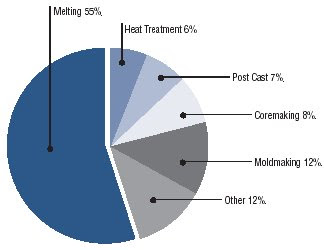
The most energy-intensive process in metal casting is melting. Companies are working on methods and practices to improve melting efficiency as well as to improve yield, thereby reducing the amount of metal that must be melted and hence the production cost.


Energy Use in Metal Casting
How to measure success?

  • Increased yield and reduced scrap — By improving the yield and reducing scrap, the amount of metal that must be melted decreases and in turn saves energy.
  • Melting efficiency - Melting represents 55% of the cost of process energy. Improvement in melting efficiency helps save energy and reduce production costs.